
When I landed in Cambodia, two members of the World Hope staff, Milet and Piep, were waiting
for me at the airport, holding a hand-woven floral garland called a Malai. It was a small gesture,
but it set the tone for everything that followed: warmth offered freely, across every barrier of
language and culture.
So much of what I learned in Cambodia came through shared meals, or “breaking bread,” as we
say, though that phrase feels a little off when rice is the star of every table! Around those tables,
and in village courtyards, and on floors of homes I was welcomed into, I began to understand
both the country and the people working to rebuild it.
Cambodian food, I discovered, carries a quiet history. During the Khmer Rouge genocide,
survival meant learning to eat what the land offered: flowers, wild plants, whatever could be
foraged. That ingenuity born of devastation hasn’t disappeared, it lives on in the flavors and in
the people themselves. The same resilience I tasted in the food, I saw in the faces of the farmers,
the mothers, and the community leaders we met. They were people comfortable holding
adversity and hope in the same breath, and generous enough to share both with strangers.
Through World Hope, we had the privilege of meeting Cambodian and indigenous Bunong
farmers, many of them women, who had been supported with seed programs to grow new
sources of food and income. In village after village, they proudly showed us their harvests:
ginger, turmeric, lemongrass. What struck me wasn’t just what they’d grown, but the quiet dignity
with which they showed it. This was theirs. They had built it.
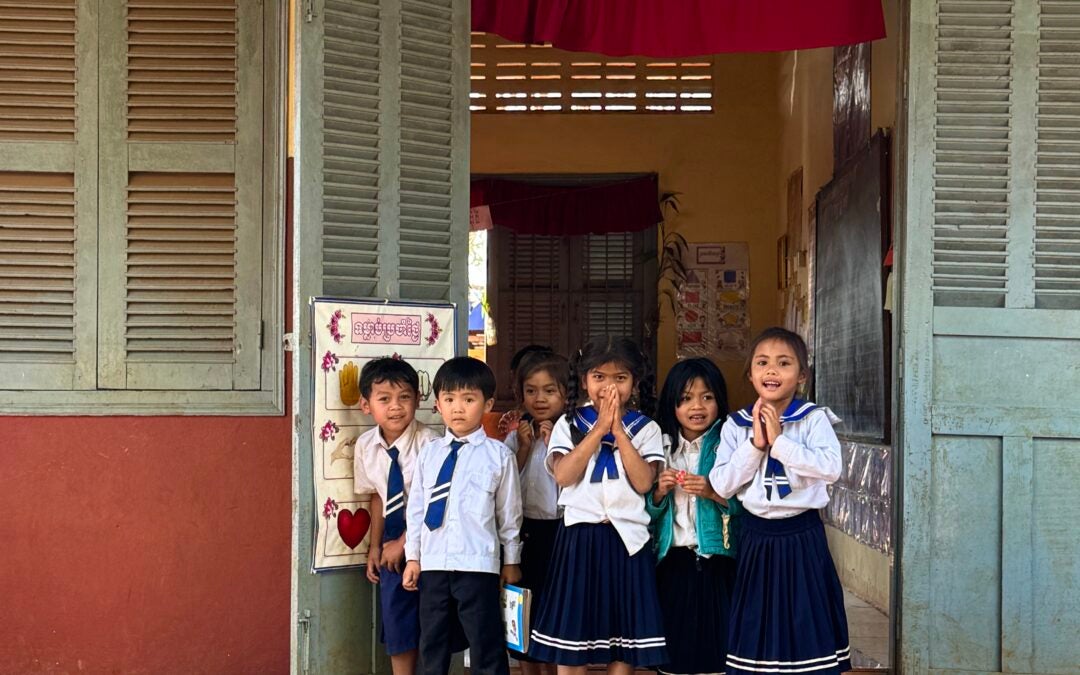
Some of my most treasured moments, though, were the unplanned ones, the hours spent simply
existing alongside children. The adults were warm and eager to share everything World Hope
had made possible for their communities, and that was profound in its own right. But there was
something irreplaceable about dropping all agenda and just observing. I taught a classroom of
kids basic origami one afternoon. No shared language, no formal program, just paper folding,
trial and error, and laughter that needed no translation. Their joy was uncomplicated and
complete, and it gave me more hope for the future of their communities than any presentation
could.
One conversation I will carry with me for a long time took place with a Bunong women’s group
about the issue of domestic violence. What struck me wasn’t only what they shared, but how
openly they shared it. World Hope’s nonviolence and anti-gender-based violence initiatives had
given these women the space to confront generational patterns they had never been invited to
question before. I sat with mothers who spoke honestly about learning not to hit their children,
about the slow, effortful work of unlearning what had been done to them. There is something
extraordinary about choosing growth, and choosing to do it in full view of your community, and
even strangers.
The Bunong indigenous community left a particular impression on me. World Hope’s work with
them centers on something I find genuinely exciting: empowering indigenous people to lead and
own ecotourism within their ancestral lands. This isn’t tourism imposed from the outside, it’s a
model that generates sustainable income while actively preserving the wildlife and ecosystems
the Bunong have always been stewards of. Nowhere was this more vivid than in their partnership
with Jahoo, a conservation initiative that has found a way to protect not only people, but animals.
Jahoo’s keystone species is the gibbon: a small, extraordinary primate that draws visitors from
around the world. We had the privilege of encountering them in their natural habitat, guided by
Bunong wayfinders who carry within them not just knowledge of the land, but the stories and
myths their people have woven around it for generations.
One of my favorite of those myths involves the pig-tailed macaque, who, legend has it, once
convinced a group of humans to abandon the obligations of farming and disappear into the forest
instead. It’s a story that feels very alive in a place where the boundary between the human world
and the natural one has never been sharply drawn. The Bunong practice animism: a worldview in
which every creature, every tree, every stone possesses a spirit. Spending time in their forest, I
began to understand why. Every morning, the gibbons sing. It is one of the great draws of the
place, and one of the most arresting sounds I have ever heard. Ancient Bunong legend holds that
the gibbon’s call is an act of mourning and memory. The Gibbons cry out, reaching back toward
something they have lost. Hearing it at dawn, in a forest tended to by people who have refused to
let their own stories be lost, felt like the land itself was speaking.
I came to Cambodia hoping to learn. I didn’t expect how much of that learning would happen in
silence: in a garland pressed into my hands at an airport, in the smile of a child holding a paper
prize, in the steady gaze of a woman telling the truth about her life, in the cry of a gibbon
echoing through ancient trees.
Gratitude, I’ve found, doesn’t need language either.